
Trace Jackson County Former Owners
A backward deed chain works one conveyance at a time. Always start from a transfer that actually happened. Jackson County's older access agreement claims its deeds reach back to patent. That statement alone cannot prove every image or name index is online. In August 2026, an AVID migration brought Laredo for frequent users and Tapestry for occasional searches. The new system's exact cutoff and controls remain unpublished.
| Source | Years It Covers | Where Held | What It Shows |
|---|---|---|---|
| Current deed index | Cutoff not published | Register / AVID products | Parties, instrument, date, and land reference when indexed |
| Register indexes | 1855-1988 | Kansas Historical Society | Grantor and grantee routes into deed books |
| Deed records | 1857-1917 | KSHS catalog and microfilm | Earlier conveyances and legal descriptions |
| Plat and atlas set | 1881, 1903, 1918, 1921 | KSHS / Kansas Memory | Roads, lots, additions, and rural owner context |
The current Register route covers the latest transfer. When a name or book reference falls beyond accessible digital material, turn to KSHS finding aids, microfilm, and the county office itself. Remember, a finding aid only proves a series exists, not that every page is online.
Build Jackson County's Transfer Timeline
Build one row per deed before drawing any conclusion. Never insert a sample person, date, or book number that did not come from the record itself. A clean worksheet keeps the chain's direction visible and exposes gaps early.
| Transfer Date | Grantor to Grantee | Deed Type | Book/Page |
|---|---|---|---|
| Latest verified date | Prior owner to current grantee | As indexed | Exact reference |
| Earlier verified date | Earlier grantor to prior owner | As indexed | Exact reference |
| Archive-era date | Names from index and deed | As recorded | Volume and page |
Beside each row, record the legal description and the source URL or call number. Quitclaim deeds, warranty deeds, executor deeds, and transfer-on-death deeds can each move an interest, yet their wording and context differ in ways that matter.
Reconstruct Jackson County Deeds Backward
Read every link in reverse chronological order. A shared surname is never enough, since two people can carry the same name and one owner can hold several tracts. The deed's legal description and recording reference keep the chain pinned to the same parcel.
- Find the newest conveyance and record the grantee, grantor, instrument date, recording date, and legal description.
- Take that grantor's name and search for the earlier deed in which that party was the grantee.
- Confirm the earlier instrument describes the same lot, block, addition, or rural tract. Track parcel splits and merges separately.
- Repeat until the digital trail ends, then carry the last book, page, date, and name into the deed books or microfilm.
- Grantor
- The party conveying an interest.
- Grantee
- The party receiving the interest.
- Chain of title
- The ordered sequence of transfers affecting the land.
- Reverse index
- An index arranged to help trace parties backward through recorded instruments.
- Quitclaim deed
- A conveyance of whatever interest the grantor has, without the warranty implied by a warranty deed.
Keep Jackson County Land Identity Fixed
Old ownership research often fails. A modern street address gets carried too far into the past. Town property usually hangs on an addition or subdivision, block, and lot. Rural land may turn on section, township, range, acreage, or metes-and-bounds calls. Preserve that wording instead of shortening it.
A parcel split or merge can break a one-to-one chain. Compare old and current parcel keys, then let the legal description show which portion moved. Mortgages, assignments, liens, and releases belong in a full title study. They do not belong in a former-owner list dressed up as conveyances.
Jackson County Address Clues Changed
Holton's official history records a house-number requirement in 1908. Earlier sources may place a property by its side of the square, a cross street, a nearby business, or a lot and block. They may not use today's number at all. Mayetta research has another strong key: Whelan's Addition. Search that exact addition name in plats and deed records. The modern address may never mention it.
Historic atlases restore lost context. The digitized 1881 Historical Plat Book holds Jackson County maps, histories, sketches, and views. Rural plat books may name landowners. City plats may show only streets, lots, blocks, and additions. Either way, the map is a clue and never proof of the deed chain.
See Jackson County's Archive Bridge
The KSHS Jackson County catalog lists the index and deed series that take over when online searching stops. The finding-aid route is the official path to those records.
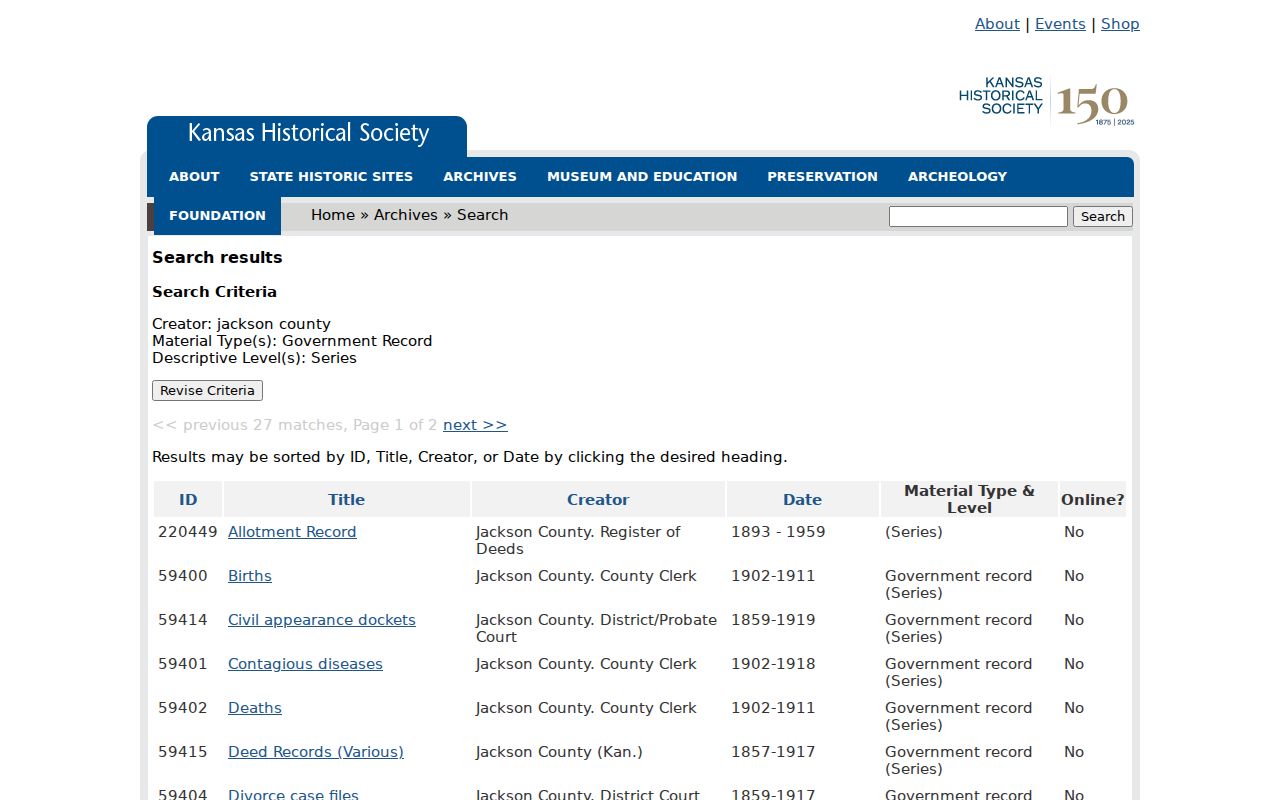
Follow the catalog with a film, volume, or reading-room request. KSHS notes that county microfilm can travel to Kansas libraries through interlibrary loan, while most archive collections are not digitized.
Untangle Jackson County Estate Transfers
A death can interrupt a simple buyer-and-seller pattern. Look for transfer-on-death deeds and joint-tenancy language. Also watch for affidavits, executor or administrator deeds, personal-representative deeds, and probate orders. An estate case in the Jackson County District Court file may explain who held authority. But the recorded transfer remains the land-record link.
Search the decedent, the estate, the representative, heir, and trust variants of each name. Some probate material never reaches the web portal. It lives only at the courthouse terminal. A death certificate is restricted under Kansas rules and does not itself transfer title.
Note: Preserve the case number and deed reference separately because the court order and recorded conveyance serve different roles.
How Deep Jackson County Records Run
KSHS identifies Register indexes from 1855 through 1988 and deed records from 1857 through 1917. It also lists land-office records from 1857 through 1868. Land-district records run from 1858 through 1862. An allotment record spans 1893 through 1959. The old county agreement says deeds reach to patent. No official source records a wholesale courthouse loss. So blame no gap on fire or flood without evidence.
The present courthouse was completed in 1921, replacing a first courthouse dated to 1872. That building history helps decode an old courthouse reference. Custody and indexing are the real questions for an assessor or deed search. Contact the Register for county originals and KSHS for catalog, microfilm, interlibrary-loan, or reading-room access. The earliest year inside the new AVID products remains a verification item.
Online cutoff unknown. Do not claim a first online year. Move older searches to Register deed books and the verified KSHS index and microfilm series.
Lawful use. Trace previous owners for house history, estate work, or land diligence; never use records to track, target, or harass a living person.